Showing posts with label Israelis. Show all posts

Wednesday, April 17, 2013

The Declaration of Independence of the State of Israel


These days my beloved Israel is celebrating 65 years of existence. It's Declaration of Independence from 14 May 1948 still best represents its ideals and values. I recommend to decent people, who really wish to understand Us Israelis better, to read it. For your convenience, here is its text in English:
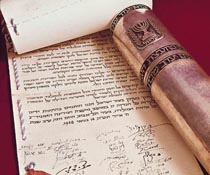
Israel's Declaration of Independence
The Declaration of Independence of the State of Israel
May 14, 1948
In the Land of Israel the Jewish People rose. Here their spiritual, religious and political identity was shaped. Here they first attained to statehood, created cultural values of national and universal significance and gave to the world the eternal Book of Books.
After being forcibly exiled from their land, the people kept faith with it throughout their Dispersion and never ceased to pray and hope for their return to it and for the restoration in it of their political freedom.
Impelled by this historic and traditional attachment, Jews strove in every successive generation to re-establish themselves in their ancient homeland. In recent decades they returned in their masses. Pioneers, defiant returnees, and defenders, they made deserts bloom, revived the Hebrew language, built villages and towns, and created a thriving community controlling its own economy and culture, loving peace but knowing how to defend itself, bringing the blessings of progress to all the country's inhabitants, and aspiring towards independent nationhood.
In the year 5657 (1897), at the summons of the spiritual father of the Jewish State, Theodore Herzl, the First Zionist Congress convened and proclaimed the right of the Jewish people to national rebirth in its own country.
This right was recognized in the Balfour Declaration of the 2nd November, 1917, and re-affirmed in the Mandate of the League of Nations which, in particular, gave international sanction to the historic connection between the Jewish people and Eretz-Israel and to the right of the Jewish people to rebuild its National Home.
The catastrophe which recently befell the Jewish people—the massacre of millions of Jews in Europe—was another clear demonstration of the urgency of solving the problem of its homelessness by re-establishing in Eretz-Israel the Jewish State, which would open the gates of the homeland wide to every Jew and confer upon the Jewish people the status of a fully privileged member of the community of nations.
Survivors of the Nazi holocaust in Europe, as well as Jews from other parts of the world, continued to migrate to Eretz-Israel, undaunted by difficulties, restrictions and dangers, and never ceased to assert their right to a life of dignity, freedom and honest toil in their national homeland.
In the Second World War, the Jewish community of this country contributed its full share to the struggle of the freedom-and peace-loving nations against the forces of Nazi wickedness and, by the blood of its soldiers and its war effort, gained the right to be reckoned among the peoples who founded the United Nations.
On the 29th November, 1947, the United Nations General Assembly passed a resolution calling for the establishment of a Jewish State in Eretz-Israel; the General Assembly required the inhabitants of Eretz-Israel to take such steps as were necessary on their part for the implementation of that resolution. This recognition by the United Nations of the right of the Jewish people to establish their State is irrevocable.
This right is the natural right of the Jewish people to be masters of their own fate, like all other nations, in their own sovereign State.
Accordingly we, members of the People’s Council, representatives of the Jewish Community of Eretz-Israel and of the Zionist Movement, are here assembled on the day of the termination of the British Mandate over Eretz-Israel and, by virtue of our natural and historic right and on the strength of the resolution of the United Nations General Assembly, hereby declare the establishment of a Jewish state in Eretz-Israel, to be known as the State of Israel.
We declare that, with effect from the moment of the termination of the Mandate being tonight, the eve of Sabbath, the 6th Iyar, 5708 (15th May, 1948), until the establishment of the elected, regular authorities of the State in accordance with the Constitution which shall be adopted by the Elected Constituent Assembly not later than the 1st October 1948, the People’s Council shall act as a Provisional Council of State, and its executive organ, the People's Administration, shall be the Provisional Government of the Jewish State, to be called "Israel."
The State of Israel will be open for Jewish immigration and for the Ingathering of the Exiles; it will foster the development of the country for the benefit of all its inhabitants; it will be based on freedom, justice and peace as envisaged by the prophets of Israel; it will ensure complete equality of social and political rights to all its inhabitants irrespective of religion, race or sex; it will guarantee freedom of religion, conscience, language, education and culture; it will safeguard the Holy Places of all religions; and it will be faithful to the principles of the Charter of the United Nations.
The State of Israel is prepared to cooperate with the agencies and representatives of the United Nations in implementing the resolution of the General Assembly of the 29th November, 1947, and will take steps to bring about the economic union of the whole of Eretz-Israel.
We appeal to the United Nations to assist the Jewish people in the building-up of its State and to receive the State of Israel into the community of nations.
We appeal—in the very midst of the onslaught launched against us now for months—to the Arab inhabitants of the State of Israel to preserve peace and participate in the upbuilding of the State on the basis of full and equal citizenship and due representation in all its provisional and permanent institutions.
We extend our hand to all neighboring states and their peoples in an offer of peace and good neighborliness, and appeal to them to establish bonds of cooperation and mutual help with the sovereign Jewish people settled in its own land. The State of Israel is prepared to do its share in a common effort for the advancement of the entire Middle East.
We appeal to the Jewish people throughout the Diaspora to rally round the Jews of Eretz-Israel in the tasks of immigration and upbuilding and to stand by them in the great struggle for the realization of the age-old dream—the redemption of Israel.
Placing our trust in the Almighty, we affix our signatures to this proclamation at this session of the provisional Council of State, on the soil of the Homeland, in the city of Tel-Aviv, on this Sabbath eve, the 5th day of Iyar, 5708 (14th May, 1948).
Signatories:
David Ben-Gurion, Daniel Auster, Mordekhai Bentov, Yitzchak Ben Zvi, Eliyahu Berligne, Fritz Bernstein, Rabbi Wolf Gold, Meir Grabovsky, Yitzchak Gruenbaum, Dr. Abraham Granovsky, Eliyahu Dobkin, Meir Wilner-Kovner, Zerach Wahrhaftig, Herzl Vardi, Rachel Cohen, Rabbi Kalman Kahana, Saadia Kobashi, Rabbi Yitzchak Meir Levin, Meir David Loewenstein, Zvi Luria, Golda Myerson, Nachum Nir, Zvi Segal, Rabbi Yehuda Leib Hacohen Fishman, David Zvi Pinkas, Aharon Zisling Moshe Kolodny, Eliezer Kaplan, Abraham Katznelson, Felix Rosenblueth, David Remez, Berl Repetur, Mordekhai Shattner, Ben Zion Sternberg, Bekhor Shitreet, Moshe Shapira, Moshe Shertok.

Thursday, June 23, 2011

About Us Israelis - Apartheid Nation

I sometimes wish words could be taxed. Maybe then people would think twice before using them so viciously and light-headedly. Unfortunately, in a world where anyone can say or write anything, anywhere, without being held accountable, words become a dangerous tool.
Calling Israel an "Apartheid Nation", and by that labeling us Israelis as bigots and racists, is a cheap shot. The ones calling us that are the same people who are conducting a de-facto apartheid policy on the basis of political views, gender, race and religion, in their own, respective, Middle-Eastern countries. When you repeat such vicious and unfounded accusation too many times, people start believing it.


In recent years, the Muslim student association in and around US campuses hold an annual "Israel Apartheid Week". It is aimed at portraying Israel as an Apartheid nation, a mass murderer of innocent civilians, a ruthless occupier of the Palestinian People and a country which does not have a right to exist. Those groups are funded and motivated by the extremist Muslim Brothers. They are allowed to hold their protest in the name of the freedoms they are deprived of in their respective countries of origin (watch the Horowitz Freedom center presentation on the matter:


South African Apartheid (1948 – 1994) was based on a political and judicial systems promoting legally sanctioned racial segregation. The regime sponsored the political, economical and social interests of the minority whites who ruled over the colored majority in the country by means of discriminatory laws. Those were enforced by repressive violent methods.
Colored people in apartheid South Africa were deprived of citizenship status and basic human rights. The government segregated the basic rights for education, medical care, transportation, social services etc., providing inferior services, if at all, to the colored majority. What was known as "Petty Apartheid" – acts of legislation and governmental decisions designed to insure the survival of the regime – prohibited mixed marriages between colored and white people, prohibited inter-race intercourse, deprived colored people from running their own businesses in professions reserved only for whites, and limited their economic activity to "colored-only" territories, set up by the regime in order to physically separate the whites from the colored. It also prohibited colored workers from forming their own trade unions, segregated public transportation and public health and public ambulance services, deprived colored people from having passports, etc.


No colored people in Apartheid South Africa could run for office or serve in the country's parliament or work for the government or practice law (let alone reside as a judge in one of the country's judicial instances), or work as a physician at a white-only hospital or teach white children, represent the country in international sports events, and again the list goes on. In Israel, all of that is legally open to all people.

Israel is not an Apartheid nation! It never was and it never will be!
Israelis are not racists! They never were and they never will be!


In Israel, all people are legally equal, regardless of race, religious persuasion, political affiliation, gender, color of skin, place of origin, cultural traditions, socio-economic circumstances, etc. People living in Israel are free to conduct their lives as they wish, free to run for office, free to practice law, free to serve in the Knesset or work in the public sector. Everyone is free to buy their own land, free to build their own house, free to marry whomever they love, free to play for in the national sports teams, free to serve as judges in Israel's various judicial instances, free to run their own business – as long as they are law-abiding citizens who do not jeopardize the lives, the happiness and the freedoms of their fellow Israelis (watch the Maoz-Israel presentation: http://www.youtube.com/watch?v=Eupkfyd1ulc&NR=1).  


Israel is not a ruthless occupier! It never was and it never will be!
Israelis are not insensitive to the suffering of others! They never were and they never will be! 


Israel has been a very active player in the international aid scene for many years. It has a long tradition of extending humanitarian aid in many forms and shapes – alleviating hunger, battling disease, helping the poor and the needy and rushing to the aid of other human beings all around the world in times of natural disasters or in light of terrorist attacks.

The same goes for Israel's attitude toward the Palestinian people. Israel extends ongoing medical assistance to sick Palestinians from the Gaza Strip who wishes to be treated in Israeli hospitals. Israel supplies the Palestinians school materials, gas for domestic use, supplies, medicine, etc., on a regular basis. Despite never-ending attacks by HamasIsrael maintains an ongoing humanitarian corridor for the transfer of perishable and staple food items to Gaza. The UN relief agencies and the Red Cross are free to use this conduit for the benefit of the Palestinian people.

Israel is a democratic country, extending rights and freedoms to all its citizens; so calling it an apartheid nation is mean and unjust. Israel does not occupy the Gaza Strip or the territories governed by the Palestinian Authority in Judea and Samaria, so accusing it of implementing an Apartheid policy in these territories is false and deceiving.


So, don't leave out this important information when coming to form an opinion about us Israelis.

Tuesday, June 14, 2011

About Us Israelis - The Region's Thugs

One thing us Israelis are very used to is being labeled, "the region's thugs". 
Whatever the reasons for the turmoil in our part of the world, we usually find ourselves on the defensive. We are always the aggressors, always the one's at fault – always the ones to be blamed.
The examples are many. The three examples which best elucidate this tendency are the 1967 Six-Day War, the 1982 Peace-for-Galilee Lebanon War, and the 1998 Cast-Lead operation in Gaza.
In 1967, Israel launched a pre-emptive attack against Egypt, after Egyptian President Nasser initiated a naval blockade by closing the Straits of Tiran into the Red Sea, kicked out UN peace-keeping troops from the Sinai Peninsula, moved his armed forces toward Israel and launched a violent rhetoric attack.
In 1982, Israel launched operation Peace for Galilee, in retaliation for the assassination attempt on the life of our ambassador to The UK, Shlomo Argov; afterwards, the PLO, which had by then occupied de-facto the southern part of Lebanon, sent terrorists from its border with Israel on a mission to kill innocent Israelis and followed this with a continuous missiles barrage against Israel's northern cities.
In 2008, after being hit by hundreds of missiles against southern Israeli towns, fired by Palestinian terrorist organizations, such as Hamas and the Islamic Jihad with no prior provocation, Israel launched operation Cast Lead, in order to put an end to the ongoing assault on the lives of us Israeli civilians.
In all cases, we found ourselves defending our right to defend ourselves. In all cases, we found ourselves being blamed for the situation. In all cases, voices were heard, labeling us "the region's thugs".
Well, I think this time I'll use one of Bob Dylan's songs to make our case. Yes, Dylan is Jewish. Yes, he's a Zionist. And, yes, he is a great supporter of the State of Israel. He is also one of the greatest song-writers of all times, who has often written about immoral behavior and human injustice, regardless of race, color, nationality or religion. In 1983, fed up with the way Israel was being covered by the international media, Dylan released the epic song, "The Neighborhood Bully". I think it would be best if I let the song speak for itself. 

Bob Dylan

It goes like this:  

Well, the neighborhood bully, he’s just one man
His enemies say he’s on their land
They got him outnumbered about a million to one
He got no place to escape to, no place to run
He’s the neighborhood bully

The neighborhood bully just lives to survive
He’s criticized and condemned for being alive
He’s not supposed to fight back, he’s supposed to have thick skin
He’s supposed to lay down and die when his door is kicked in
He’s the neighborhood bully

The neighborhood bully's been driven out of every land
He’s wandered the earth an exiled man
Seen his family scattered, his people hounded and torn
He’s always on trial for just being born
He’s the neighborhood bully

Well, he knocked out a lynch mob, he was criticized
Old women condemned him, said he should apologize
Then he destroyed a bomb factory, nobody was glad
The bombs were meant for him. He was supposed to feel bad
He’s the neighborhood bully

Well, the chances are against it and the odds are slim
That he’ll live by the rules that the world makes for him
’Cause there’s a noose at his neck and a gun at his back
And a license to kill him is given out to every maniac
He’s the neighborhood bully

He got no allies to really speak of
What he gets he must pay for, he don’t get it out of love
He buys obsolete weapons and he won’t be denied
But no one sends flesh and blood to fight by his side
He’s the neighborhood bully

Well, he’s surrounded by pacifists who all want peace
They pray for it nightly that the bloodshed must cease
Now, they wouldn’t hurt a fly. To hurt one they would weep
They lay and they wait for this bully to fall asleep
He’s the neighborhood bully

Every empire that’s enslaved him is gone
Egypt and Rome, even the great Babylon
He’s made a garden of paradise in the desert sand
In bed with nobody, under no one’s command
He’s the neighborhood bully

Now his holiest books have been trampled upon
No contract he signed was worth what it was written on
He took the crumbs of the world and he turned it into wealth
Took sickness and disease and he turned it into health
He’s the neighborhood bully

What’s anybody indebted to him for?
Nothin’, they say. He just likes to cause war
Pride and prejudice and superstition indeed
They wait for this bully like a dog waits to feed
He’s the neighborhood bully

What has he done to wear so many scars?
Does he change the course of rivers?
Does he pollute the moon and stars?
Neighborhood bully, standing on the hill
Running out the clock, time standing still
Neighborhood bully

For a song written three decades ago, it sure sounds contemporary, doesn't it?

Now, please consider this when forming your opinion about us Israelis

Wednesday, June 8, 2011

About Us Israelis - The Unifying Element of Judaism


In a previous blog entry titled The Burden of History, I tried to explain how Israelis of the Jewish faith are born into complex circumstances, carrying on their shoulders from day one, not only the weight of their people's long history, but also that of their embattled homeland's. This complicated reality is also one of the most important and overwhelming elements in our identity. It glues us Israelis together, despite the so-many differences dividing us on other fronts – mainly on the political, cultural and religious ones. This glue is called Judaism.

I don't want to tire you with huge questions, like: what is Judaism? Who is a Jew? Or, what it means to be a Jew? I am not an expert on the matter, and it won't serve my blog's purpose to help you understand us Israelis any better. My intention is to try and explain in a short article how Judaism works to connect us Israelis together, no matter what the internal or external circumstances are.
Judaism for Jews all over the world, but especially for us Israelis, is not simply a word which describes a chosen religious path. Judaism has to do, first and foremost, with our identity. Being a Jew means being a member of a people, distinct from other peoples ethnically, religiously, culturally and historically. As such, distinctions amongst us Israelis of the Jewish faith, like the place of origin and its distinctive culture and traditions, have a lesser impact than they might have elsewhere. In this respect, Judaism allows us to share a common infrastructure of beliefs and values that we consider superior to anything else.
Judaism also symbolizes our common fate. This element in our Jewish identity is so powerful that it influences the way we catch and interpret national and international reality. Israel was created, among others, to safeguard our fate as a people – the Jewish people. Jews were mistreated and persecuted throughout history, not because of their political views or for being unfaithful to their respective homelands. They were mistreated for being Jewish. Remembering history and learning from it has left us with the firm conviction that being stateless and weak is something we cannot afford – if we wish to survive as a people.

The Western Wall - One of Judaism Holliest Places
(Photo Courtesy of Israel Ministry of Tourism)

In his monumental book, The Clash of Civilization, Samuel Huntington claims that a civilization, economically rich and strong as it might be, would still be in great danger if immigration into it would not meet two conditions, one of them being the assimilation and integration of the immigrants into the host society, without changing its identity or succumbing to its distinct cultural pressures for change (the second one is less relevant to our case, dealing with the utilization of the most skilled of immigrants for the benefit of the hosting civilization). He goes further to claim that a civilization cannot survive if, inside of it, other distinct civilizations struggle for dominance. 
How is this relevant to our case?
Judaism is the "super-glue" that keeps us Israelis of the Jewish faith together, giving us the capacity to sustain a country or a civilization – as Huntington might put it – despite being so culturally diverse. For the last two decades, Israeli governments have been encouraging cultural diversity and teaching inter-cultural tolerance. Israel is an immigrant society by definition, and we feel committed to absorb Jews from everywhere, anytime. The result is a very colorful and multi-facetted society, where Jews from Ethiopia, Russia, France, Morocco, Iran and the United States live together in the same apartment building, while their children attend the same classes in the neighborhood's school. I won't lie to you, it is not always silky smooth and we do have our share of problems, but we do our best to fix things as we move along.
Where in other societies, scholars, like Huntington, see societies with diverse cultural identities as a source of social disintegration and political instability; we see it as a beautiful characteristic of our society and are confident in our ability to sustain our unique civilization nonetheless. Our confidence derives from relying on something that has never failed us – our common super-infrastructure in the form and shape of our Jewish identity and values. In this respect, the Israeli experience is proving to be distinctive, defying Huntington's otherwise very sound historical conclusions.  
Thus, for us Israelis, Israel must be a Jewish state. It should remain the country that was created to serve as the safe haven for Jews all around the world if and when the serpent head of anti-Semitism rises again. This is also why most Israelis, for the past decade, have supported the concept of a Two-State Solution to the Israeli-Palestinian conflict – despite the painful territorial cost in terms of the promised land of Israel it might involve. Most Israelis believe today that the One-State Solution, once a very popular idea amongst Israelis, left and right of the political wings, would result in the continuing clash for dominance of the two main civilizations sharing the land – the Jewish and the Arab.
Jews Praying In front of the Western Wall
(Photo Courtesy of Israel Ministry of Tourism)

In trying to understand us Israelis, one must take into account that we see ourselves first and foremost as Jews. Anybody out there who thinks he can get to second base with any of our future governments regarding a future political settlement without accepting the fact that Israel is and always will be a Jewish state, deems his efforts to complete failure.
So, keep this also in mind when forming your opinion about us Israelis

Tuesday, May 31, 2011

About Us Israelis – Israel's Indefensible Borders

One thing that is a constant thorn in the eye for us Israelis, being so small in numbers and territory, is our vulnerable geography. Nothing I can write would do justice to our concerns about what we consider to be indefensible borders.
Consider this: Notwithstanding missiles attacks against Israel from almost anywhere in the Middle East, it would take a jet fighter, entering Israel from the Jordan valley, only four minutes to reach the Mediterranean Sea and less than two minutes, if not intercepted in time by Israel's Air Force, to reach and bomb Jerusalem (watch the Jerusalem Center for Public Affairs' excellent YOUTUBE presentation on the matter: http://www.youtube.com/watch?v=ytWmPqY8TE0).
When dealing with what the majority of Israelis find unacceptable, and is known as "the 1967 borders as a basis for an agreement between Israel and the Palestinians", one must understand the true meaning of such a settlement to our sense of security. We feel indefensible as it is. Imagine what giving up crucial territorial strategic depth means to our ability to safeguard Israelis all around Israel.


Security is not something we would ever compromise. Remember, we are the remains of a defenseless people led to the ovens of the Nazi death camps. We vowed – never again!  And by that we mean – never again! I'm not trying to use pathos here in order to make a case. This conviction is embedded in our national psyche, and it is what leads most Israelis in their approach to their security and to any future peace settlement. The quicker people realize that, the better the chances of a future peace settlement would become.
Abba Eben, one of Israel's iconic leaders and former Israeli Minister of Foreign Affairs, was quoted saying to Der Spiegel in 1969: "…the map will never again be the same as on June 4, 1967. For us, this is a matter of security and of principles. The June map is for us equivalent to insecurity and danger. I do not exaggerate when I say that it has for us something of a memory of Auschwitz."
Having defensible borders is something so elementary that even UN security resolution 242, which was waved in our faces and used against us so many times (and not only by our foes – mind you), states explicitly that every state in the Middle East has a "right to live in peace within secure and recognized boundaries free from threats or acts of force."
One must understand that, contrary to other countries – Germany or Japan in the aftermath of World War II, for example – Israel would never get a second chance if it was defeated in the battle field. The Israeli Defense Forces cannot miscalculate its military plans or fail to protect the only Jewish state in the world. Failure of the IDF to do that means the complete annihilation of the country and its people. This is not an exaggeration – our enemies state it out loud. In order to diminish the risk of failure in the battlefield, Israel must have defensible borders – or at least as defensible as possible.
Historically speaking, the legal bases for the establishment of the State of Israel was the League of Nations'  resolution, unanimously adopted in 1922, affirming the national home for the Jewish People in the historical area of the Land of Israel (which includes the areas of Judea, Samaria and Jerusalem). The borderline drawn in the 1949 armistice agreements between Israel and its neighbors was militaristic. It was not a permanent political border. The occupation of Judea and Samaria by the Kingdom of Jordan in 1948 was the result of an illegal invasion. In fact, the only countries ever to recognize Judea and Samaria as Jordanian territory were Britain and Pakistan. In this respect, as most Israelis grasp it, the 1967 war, which was forced on Israel by Egyptian President Nasser and by Jordanian King Hussein, just corrected a historical injustice.  
Now, don't get me wrong. I'm all for peace and I'm in good company. Polls made in Israel in recent years show beyond any doubt that the majority of Israelis are all for peace too and would be ready, under the right security provisions, to make some painful territorial concessions. All our Prime Ministers in the last decade - left, center and right of the political map - have stated that publically and explicitly. Yet, one must realize that most Israelis would never support any peace settlement that would endanger the security of their children, leaving Israel with indefensible borders.
So, add also this consideration to the growing number of others, when forming your opinion about us Israelis

Monday, May 23, 2011

About Us Israelis - Singling Us Out

Unfortunately, our reputation as a people, unjustly and harmfully, is targeted by our politically motivated foes. These biased and one-sided advocates of the Arab, Iranian and Palestinian political agendas are claiming false and outrageous claims against us, with no proof whatsoever on the ground. Yet, their massive numbers, their growing presence in university campuses around the world, their oil-industry-generated money, their conniving ways of dealing with the international media, their mischievous tactics of spreading disinformation, their automatic majority in international organizations and their growing political strength (due to their growing numbers in and around the countries of the world), leaves us Israelis unable to match their overwhelming influence on international public opinion.
So, to our great misfortune, the false and biased labels stick.

The Coast of Tel Aviv As Captured From Old Jaffa
(Photo Courtesy of Israel Ministry of Tourism)

I never blame ordinary citizens of the world for criticizing us. I don't even blame them when their criticism becomes sheer hatred. In some countries around the world it is simply a matter of available - or unavailable - information. In others – indoctrination. People are intelligent. They think for themselves and construct their own worldview. They do it in light of the information presented to them. When they hear, day in and day out, from their own respected news media corporations, that Israelis are vicious, ruthless occupiers, that they are war mongers who support a Nazi-like or an apartheid regime, and receive images to support these claims, they form their opinion on the matter accordingly. 
The only problem here is balance – or the lack of it.
Living abroad, receiving all their information about the events unfolding in Israel on a daily basis, Israelis finds themselves shocked and offended by local or by international media coverage of these same events. It usually boosts the narrative of the "underdog" and adds conveniently collected images to fit that narrative. Rarely do you get to see and hear the other side's story. If it happens, it would never match the emphasis the underdog's narrative is getting or the intensity of its arguments.
Humans are compassionate. Thank God for that. Their instinct-based inclination would usually be to support the underdog in a story – any story. We all identify with the underdog characters in a movie we see or in a book we read. The only trouble is that the underdog is not necessarily always right, or just or humane. When the Palestinians launch a rocket attack or send suicide bombers to kill Israeli civilians, targeting intentionally helpless innocent people - woman and children included - they are not right or just or humane. Nothing can justify such inhumane atrocities. They have a mission to innihilate the Jewish state and kill the Jews, as the Hamas charter proudly states. 
Covering the Israeli response to the usually unprovoked terrorist actions against us launched by the "underdog" without showing the whole picture, without telling the full story, has unfortunately become common in recent years. It provides a great source of images for our foes to use against us cynically.   
Being such a small people used to be isolated and sigled out in international forums, used to the one-sided coverage by the international news media (which sometimes act out of fear of the oil-rich Arab wrath), Israelis feel helpless, powerless and vulnerable. This does not mean we are sitting idly-by. We do have excellent diplomats working in our embassies and consulates around the world. But these skilled professionals, who fight to safeguard our people's reputation and honor, are a drop in the ocean considering the overwhelming capacity of Arab, Iranian and Palestinian disinformation machines.

The Sea of Galilee

The result is the isolation of a people based on lies and misconceptions. Worse, this false and vicious filth that is thrown at our face on a regular basis is done with no comparison to other countries.  "…those who single out Israel for unique criticism not directed against countries with far worse human rights records," wrote Prof. Alan Dershovitz in the introduction to his remarkable book The case for Israel, "are themselves guilty of international bigotry."
For us Israelis, singling us out time and again is unacceptable. It creates a wall of distrust between us and most of the international political community (not the peoples – mind you). We feel mistreated and we feel isolated. This comes on top of other considerations I outlined in previous articles in this blog and will outline in future ones. Feeling this way – can you blame us for being suspicious about the different political initiatives concerning our region that are coming frequently our way? Can you blame us for having our shields always wide open?
"Criticizing Israel is not anti-Semitic, and saying so is vile," wrote New York Times' Columnist Thomas L. Friedman a few years ago. "Singling out Israel for opprobrium and international sanction – out of all proportion to any other party in the Middle Eastis anti-Semitic, and not saying so is dishonest." (New York Times, October 16, 2002).
I guess in our cynical world, it is not enough for a country to be the only liberal-democracy in a region packed with corrupt and despotic regimes, to share universal values with the most advanced peoples of the world, to have one of the most respected judicial systems in the world, to produce Nobel Prize winners in numbers relatively unmatched, to contribute to humanity in many fields such as medicine, hi-technology, mathematics, chemistry, physics, agriculture, etc., to assist nations in dire straits time and again (the last ones were Haiti and Japan), to prove the peace-loving nature of its people by keeping a sustainable peace with two of its once fiercest enemies, to secede the land of its forefathers to the Palestinians twice in the past in hope of marching toward peace (and getting terror in return) and to extend its hand in peace to its enemies time and again.
So, if the truth matters to you, remember this before constructing your worldview about us Israelis. 

Monday, May 9, 2011

About Us Israelis - The Promised Land of Israel

In our journey thus far we have highlighted some core issues in the different stations along the path leading to understanding what goes on inside the hearts and minds of Israelis of the Jewish faith. It is time to bring into our discussion the historical narrative of what usually ignites fierce political and international dispute – the rights over the Land of Israel.
Although I have no intention of getting into the sphere of political arguments, it is almost impossible to understand us Israelis without understanding our deep-rooted spiritual, emotional, physical and religious connection to what we consider not only the land of our forefathers, but also the land promised to us – the Jewish people – by God himself.


Jews were living in the land of Israel 1000 years before the Roman Empire crushed the Jewish rebellion, demolished the second Temple and expelled hundreds of thousands of Jews from their holy, promised, land. That was about 2000 years ago. In order to wipe out the memory of the kingdom of David forever, the Romans called the land of Judaea "Palestina", thereby promoting the biblical arch-enemies of the Jewish people – the "Philistines" (not the same people as today's Palestinians). Since then, the land of Israel was considered Palestine.
From that era until the twentieth century, no national entity, ancient, historical or modern, was established in the land of Israel, and no ruler of the different empires chose Jerusalem as his empire's capital. The land was conquered time and again by different peoples, but they did not stay long enough to matter. Yet, one ancient people, even if persecuted continuously, stuck to the land of its forefathers and were always there to populate it – the Jewish people. Throughout time, the number of Jews in the land of Israel changed according to historical circumstance. It diminished when the rulers of the land prosecuted them and increased when times improved.
At its peak, the Ottoman Empire ruled over vast territories in the Middle East, in the north of Africa and in Eastern Europe. The land of Israel was divided into numerous areas and was considered a part of the Ottoman district of Syria. During the 17th and 18th centuries, the area witnessed favorable financial conditions, but during the decades preceding the Ottoman Empire’s demise, the area's economic situation deteriorated, the people of the region became poor and the land desolate.
After the First World War, the Middle East was divided between the winning allied nations of France and Britain, acting under the umbrella of the League of Nations. Most of the countries in today’s Middle East were created artificially by the occupying allies, including countries like Iraq and Syria.
There was never a national or a political entity, Arab of otherwise, claiming the right to the land of Israel - until the 20th century. The land of Israel, including the Gaza Strip, West and East Banks of the Jordan River, were never before 1948 under any rule of a sovereign modern nation-state. Israel's war of independence saw the Gaza strip occupied by Egypt and the West Bank taken forcefully by King Abdulla of Jordan. Both were freed by Israel during the Six Days War of 1967.


Aspiring always for peace and wishing to truly and wholeheartedly solve the Palestinian problem, Israel signed the Oslo accord in 1993 and moved out from most of Gaza and from most of the Palestinian towns and villages in the West Bank. Israel went even further, about a decade later, to dissolve all Jewish settlements in the Gaza Strip, uprooting Jews from their homes. All of these came at a heavy price to national unity and to human lives (soon after, Hamas took control of Gaza and has been shelling the southern part of Israel ever since).
But for us Israelis, the significance of the Land of Israel goes beyond any territorial dispute. Centuries of atrocities against the Jewish people, culminating in the mass murder of our people in the German Death Camps during World War II, were all a direct result of being stateless. The fact that the land of Israel was promised to the Jewish People by God, the fact that our only kingdom was established on its soil 3000 years ago, the fact that it is our religious place under the sun and the fact the Jews have been living in the Land of Israel continuously for 3000 years, way before anyone had heard of a Palestinian People, was enough for Zionist philosophers and activists to form a national movement that eventually brought about the establishment of the State of Israel in the land of their fathers.
Since the 1880s Zionist Jews immigrated to the Promised Land and assisted in strengthening the already existing Jewish presence and institutions, forming some new ones. Israel was established in 1948 and has since absorbed millions of displaced Jews from all over the world.  
Putting aside the political dispute over the Land of Israel, which is widespread throughout cyber space, one must realize that inside of us Israelis beats a heart filled with love for the land and its history. It was promised to us and we were here first. In fact, we never left and those immigrating to the land of Israel simply returned after being deported forcefully during millennia of atrocities against them and their ancestors.
This is how we feel. This is what we believe to be true. This is something Israelis could never compromise and are forced to pay for with the precious blood of their children to keep safe. Whoever wants to really solve the dispute must bear this in mind; otherwise his efforts are doomed to failure.
So, add this to the mountain of considerations before constructing your worldview about us Israelis.

Monday, April 25, 2011

About Us Israelis - The Shrinking of the Jewish People

The diminishing number of the Jewish People is a dark cloud always looming over our heads.
The most troubling example is the low birthrate (just above 1 child per family) and the high intermarriage rate (more than 50%) that have caused the largest Jewish community outside Israel – that of the United States – to shrink by approximately 1 million during the last generation. Since the 1980s, US American Jewry shrunk from about 6 million strong to barely 5.
For more than a decade, Jewish population growth worldwide has been steady at around 0.3% percent, compared to a worldwide population growth of more than 1%. This is due largely to the compensation in birthrate of Jews inside Israel (an average of 3 children per family). Birthrates among the Jews of the Diaspora are in negative percentages, and they keep on dropping. In short, our demography as a people is in dire straits: we bring fewer children into the world and marry more and more outside the boundaries of our faith.
For us Jews, this means deep trouble, but for us Israelis, looking at the distant future, this could mean calamity. If we put the fate of the Jewish people aside, for a moment, and consider the fate of Israel as the only Jewish country in the world, we quickly realize that the shrinking of the Jewish People living in the Diaspora would leave Israel's fate in great danger.  
Facing an automatic majority, working against us in almost any international organization or forum, regardless of the issue on the agenda (21 Arab countries plus another 26 countries with Muslim majorities) Israelis feel alone and singled out in a complicated and uneven international environment. In fact, if it weren't for the decency and kindness of the American people and the might of the great United States of America, who knows what would have become of us by now.
We need our brothers and sisters in the Diaspora to help us explain our positions and actions to their own governments, to help us expose the Israeli narrative to them, to force them to look beyond their economic interests, which are usually deeply rooted in Arab oil or in the huge markets of the Muslim world. The shrinking of the Jewish People of the Diaspora could mean leaving the task of influencing the international community exclusively in the hands of our foes.   
Jewish and Israeli leaders, acknowledging this strategic problem, conceived two programs intended to strengthen the connection between young Jews and their heritage. The first of those programs is "Taglit - Birthright Israel" ("Taglit" in Hebrew means discovery), in which young Jews arrive for a 10-day tour of Israel. The second is "Masa" (voyage in Hebrew) in which thousands of young Jews spend a semester or a whole school year in Israel, helping them build a long-lasting relationship with Israel and Israelis. The goal of both programs is to try and keep these young men and women of the Jewish faith linked to our people.
Successful and innovative as they are, those programs are a drop in the ocean. The Jewish People is shrinking at a troubling rate and, although we will endlessly keep on trying, it seems there is nothing we can do to stop this disturbing inclination.
So, please consider this before forming your opinion about us Israelis. 

Sunday, April 10, 2011

About Us Israelis - No Black and White

Dressing them in uniform and exposing our innocent sons and daughters, young 18 year old high-school graduates, to one of the world's most complex conflicts, has a price beyond comprehension for both parents and children. It is a difficult thing to explain to those around the world, as they sit in the comfort of their homes and watch international news coverage from Israel. Most people have never had to experience the dread Israeli parents feel when they send their children to serve in the Israeli Defense Forces, or the physical strain and the moral dilemmas our children face on a daily basis as soldiers.
Some years ago, attending a lecture in Oslo given to Norwegian journalists by Amos Oz – one of Israel's leading authors and intellectuals – I heard him say something that left a big mark on me: "In the conflict with the people sharing the land of our fathers with us," he said, "there is no black or white, no wrong or right, no good or bad, and no villains. There are only good and innocent people on both sides, which circumstances have led to claim the right to the same piece of land. These people have the same feelings, desires, hopes and dreams that you have here among the beautiful fjords of Norway. So don’t be quick to judge them harshly."
As a young IDF soldier during the first Intifada, I, as many of my soldier friends, experienced some very complicated situations. I described some of them in one of my novels, titled Fate's Open Arms. To give you some sense, in a nut shell, of some of the dilemmas, I offer you relevant excerpts:

The first days of the first Palestinian “intifada” caught me as a young squad commander. A year later, after completing a service period of seven months in the Gaza strip and another five in several other Palestinian towns and villages in the West Bank, my innocent view of the world was not so innocent anymore.
The Palestinian animosity toward us in our everyday police work was beyond my capacity to comprehend. Here was one of the strongest and most sophisticated armies in the world standing helpless against hundreds of small children and teenagers, who threw stones, metal objects, and Molotov cocktails at its young soldiers. And this world-renown and respected army did not know how to effectively respond to it. This scenario was never fully anticipated. The IDF was not equipped or trained, for that matter, to execute police work. We were trained to win wars using tanks, battleships, and jet fighter planes. The international media documented this fact with its cameras every single day and screened it, to our embarrassment, twenty-four hours a day for the whole world to see.
The worst parts of it were the morality aspects. There we stood, fully equipped to overrun any army in the Middle East, any terrorist group, or any other enemy who endangered our civilian population; and in front of us, most of the time, small children and young teenagers were throwing stones and other objects at us. We did not want to be there. We all had brothers and sisters that age back home. It was an impossible and unfair situation for us, the young foot soldiers. Circumstances and past mistakes of our country’s leadership were affecting us, the innocent children of Israel, with the worst consequences.
It was a time of great despair for me, a young officer doing dirty jobs in the refugee camps and in the streets of the Palestinian towns and villages. Our commanders were no less at a loss. Time passed, and we grasped that our actions did not calm the situation and maybe even made it worse. Like the mythological Greek monster Hydra, who grew two heads for every one it lost, the intifada intensified regardless of our actions or reactions, and nothing we did could bring it to a halt. (Ofer Mazar, Fate's Open Arms, Eloquent Books, New York, NY, 2010, pp. 19-20)

Consider all of that, if you will, when forming your opinion about us Israelis.

Thursday, April 7, 2011

About Us Israelis - Security and the Rule of Law

In a land where existential threats are a daily reality, our legal system is one of the most important barriers against tyranny. The first Israeli biblical leaders after the conquest of the land by Joshua were judges. For us Israelis, a judge is tantamount to being a leader.
Israelis are forced by circumstance to continuously carry with them an uneasy tension between the rule of law and the need to secure life and their country's survival. Finding ourselves at war with our neighbors from day one, and living ever since under a Damoclean threat to our lives, Israelis have forced their leaders to come up with a security apparatus that allows us a certain degree of protection. On the other hand, as a modern nation that evolved from a combination of ancient traditions and a modern Zionist philosophy – which holds dear to its heart values such as self-determination, democracy and pluralism – we have also forced our leaders to establish a modern, sustainable, pluralistic and democratic state.
Immediately upon the declaration of their State by Israel's first Prime Minister, David Ben Gurion, Israelis found themselves being stormed by the armies of five Arab states, openly declaring their intention to completely destroy the newly-born Jewish state. Ever since, we've been through six additional wars, two bloody intifadas, countless border infiltrations, countless horrific terrorist attacks – at home and abroad – periods of continuous shelling from Lebanon and from the Gaza Strip, car bombs, suicide bombers on busses, in cafés, in market places, at hangout places for Israeli teenagers, at hotels etc. Alongside all that, always hanging above our heads, were threats from one neighbor or another (and some further off geographically) to annihilate us.
The ongoing effort to secure the lives of Israelis against all external and internal threats is a great challenge, first and foremost to Democracy and to the rule of law. This is especially reinforced when countries in a constant state of danger are placed under a partial or complete state of emergency. Israel has been in danger since the day it was created, and it is still under a state of emergency. This fact poses a massive challenge to the rule of law, to civic freedoms and sometimes to basic human rights.
The fact that Israel is still very much democratic, even if at a very high cost in terms of human life, is proof that it is succeeding in meeting that challenge. The fact that it meets the challenge is an undeniable proof that Israelis regards these freedoms and human rights as no less important than their security. One has only to examine Israel's High Court decisions, which sometimes overrule the army's or the government's actions or intentions, to realize how much Democracy is a crucial component of Israeli civic identity. 
Prof. Menachem Hofnung, of the Hebrew University, who is a specialist on the matter, claims that Israel is a particular phenomenon. It is the only democratic country which has managed to maintain its Democracy intact for such a long time, while being under a constant state of emergency. The Israeli case is also unique in light of the fact that, modern democracies are rarely faced with an inner or external threat to the lives of their citizens or to the character of their regime. They rarely go to war and usually enjoy long periods of peace and stable international relations.
Well, not in democratic Israel. Our democracy has survived not only external threats, which usually bear the affect of uniting the different political and social groups in order to eliminate the threat, but also internal, which can bring about the end of democracy.
Israel's democracy is still very much alive and kicking, despite external and internal threats. This can be attributed to us Israelis, the voters who decide the character and direction of the only real democracy in our region, and the cadre that supplies the much-appreciated and enlightened judges for our judicial system, which stands tall, guarding the tower of our Democracy.
So, bear this in mind when forming your conclusion about us Israelis.